Colors of Money in DoD / DoW: What Defense Contractors Need to Know

In the Department of War, money is not interchangeable. Every appropriation comes with a defined purpose, a set period of availability, and its own rules.
These funding categories are called the colors of money — and every government contractor should know how to read them.
A program's color of money tells you what stage the customer is in: Funding early research, building a prototype, buying production systems, sustaining fielded equipment, or constructing a facility. It also tells business development teams when an opportunity is likely to surface and what kind of contract may follow.
This guide covers the major colors of money in DoD / DoW, what each one funds, and how Belisar turns that budget data into market intelligence you can act on.
What are the DoW / DoD colors of money?
"Colors of money" is the informal name for the appropriation categories Congress uses to fund defense activities in the Department of War.
Each color answers four questions:
- What can the funding buy?
- When can it be obligated?
- How long does it stay available?
- Which fiscal and acquisition rules govern it?
A large program budget is not one flexible pool. For example, $100 million appropriated for research and development generally can't be redirected to production or routine operational support. It’s allocated to a specific purpose.
For contractors, the size of a budget is only part of the story. Its color, timing, owning organization, and position in the budget hierarchy matter just as much. Understanding the full picture helps contractors direct their resources and efforts to the most promising areas, at the right time.
The five major DoD colors of money
The principal defense appropriation categories are RDT&E, Procurement, Operations and Maintenance, Military Construction and Military Personnel.
RDT&E: Research, Development, Test and Evaluation
RDT&E funds the development and testing of new capabilities before full-scale production. It is often the first visible sign that the government is investing in a new capability.
Common uses include things like:
- Basic and applied research
- Advanced technology development
- Prototyping
- Systems integration
- Software development
- Operational testing
- Engineering and manufacturing development
- Technology demonstrations
RDT&E also funds the DoW’s SBIR and STTR programs. Each is paid for with a fixed share of the budget, so Phase I and Phase II awards come out of RDT&E. For many small and nontraditional companies, SBIR is the first time they touch a color of money.
Rising RDT&E can point to experimentation, technical maturation or expanded testing. Look at the underlying program elements and projects to see whether the work is still conceptual, moving into prototype development or nearing an acquisition milestone.
RDT&E matters most to technology companies, engineering firms, labs, software providers and nontraditional defense contractors.
Procurement: Funding production and fielding
Procurement funds the purchase of production systems and other end items. A shift from RDT&E to Procurement is one of the clearest signs that a program is moving from development toward production.
It can cover:
- Aircraft, ships, vehicles and weapons
- Communications and sensor systems
- Production hardware
- Mission equipment
- Ammunition
- Spares associated with fielding
- System modifications and upgrades
Look past the total procurement amount. Planned quantities, unit costs, funding growth, schedule changes and the five-year budget profile show whether a program is scaling up, holding steady, or pulling back.
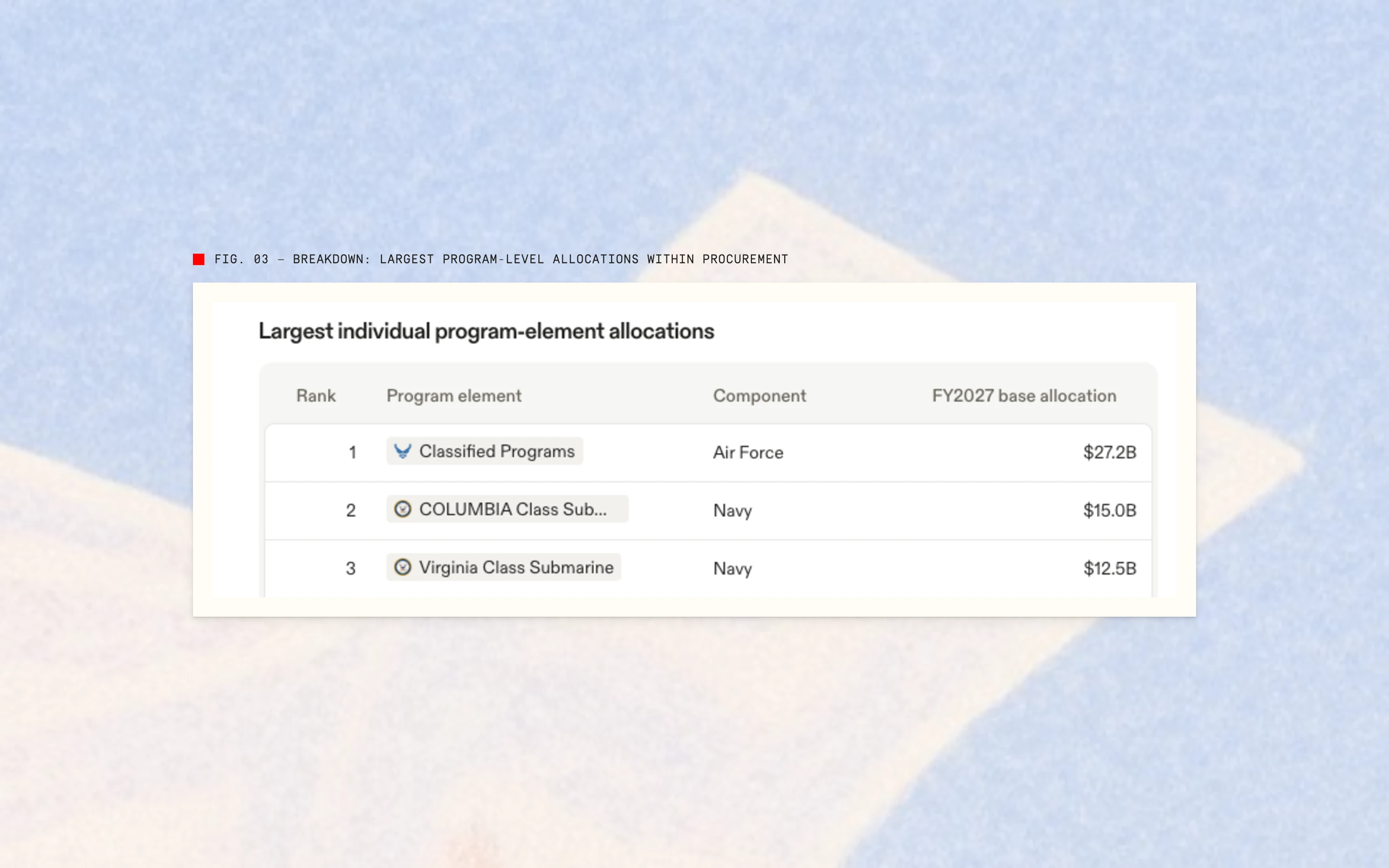
For subcontractors and component suppliers, procurement growth also points to opportunities several tiers below the prime.
O&M: Operations and Maintenance
Operations and Maintenance (O&M) funds the day-to-day operation and readiness of the force.
Common uses:
- Equipment maintenance and repair
- Logistics and supply support
- Training
- Base operations
- IT and cloud services
- Cybersecurity operations
- Professional services
- Fuel and consumable supplies
- Support for fielded systems
O&M generally expires sooner than RDT&E or Procurement funding, which makes it central to near-term contracting activity and recompete analysis.
For service providers, O&M is often the most addressable color. It funds recurring requirements like maintenance, systems administration, training, logistics, engineering support and operational software.
When O&M grows after a procurement increase, a sustainment market may be forming around a newly fielded system.
MILCON: Military Construction
Military Construction (MILCON) funds major construction and installation projects.
Examples:
- Aircraft hangars
- Maintenance facilities
- Training ranges
- Operations centers
- Utilities and energy infrastructure
- Storage facilities
- Installation modernization
MILCON creates direct opportunities for architecture, engineering and construction firms. It's also an indirect signal for everyone else in the ecosystem.
Funding for a new hangar, data center, test range or operations facility can mean a mission is expanding or a new system is approaching deployment.
MILPER: Military Personnel
Military Personnel (MILPER) funds military pay, allowances, benefits and other personnel costs.
MILPER is less directly addressable by a contractor than RDT&E, Procurement or O&M, but it's still a useful market signal.
Changes in MILPER funding can indicate:
- Expanding force structure
- Growth in a mission area
- New operational units
- Increased training requirements
- Shifts in geographic posture
- Demand for supporting infrastructure and services
Use these changes to anticipate related requirements in O&M, Procurement and MILCON.
How colors of money change across a program
Most major defense programs draw on more than one appropriation over their lifecycle.
Take a hypothetical autonomous aircraft program:
Understanding that progression is competitive intelligence, because it enables you to plan ahead for when your organization’s offering aligns with the color of money available in any given budget year.
Rising RDT&E means the customer may still be working through technical questions. Falling development funding alongside rising Procurement suggests a transition to production. Once systems are fielded, O&M demand builds around training, maintenance, logistics, software support and upgrades.
SBIR and the Colors of Money
The SBIR (Small Business Innovation Research) program is a good example of why colors of money matter to small businesses.
Phase I and Phase II are funded from the SBIR/STTR (Small Business Technology Transfer) budgets set aside within RDT&E. Phase III has no set-aside. It runs on non-SBIR funds: RDT&E, Procurement or O&M, depending on the work. A program office that wants to keep developing, fielding or sustaining your technology needs a budget line in the right color to pay for it.
That’s why so many companies stall after Phase II. The technology is proven, but no customer has yet budgeted for the next step of deployment or implementation.
If you hold a Phase II, find the program elements and procurement lines that match your capability, see whether they’re growing, and learn who owns them. Do this well before your Phase II ends.
Useful analysis tracks how funding moves between colors and across fiscal years. Individual budget numbers in isolation don’t give you the necessary context to understand how money is moving and how programs are progressing.
What DoW/ DoD colors of money tell contractors
Colors of money help business development and capture teams answer four practical questions.
How mature is the program?
A program funded mostly through RDT&E will have different requirements and acquisition pathways than one with substantial Procurement funding.
Who is positioned to compete?
RDT&E favors research, engineering, prototyping and software firms. Procurement favors manufacturers, integrators and component suppliers. O&M drives demand for services, sustainment, training and logistics providers.
When will an opportunity emerge?
RDT&E growth can precede prototype solicitations. Procurement growth can signal production competitions or supplier demand. O&M growth can point to upcoming support contracts or recompetes.
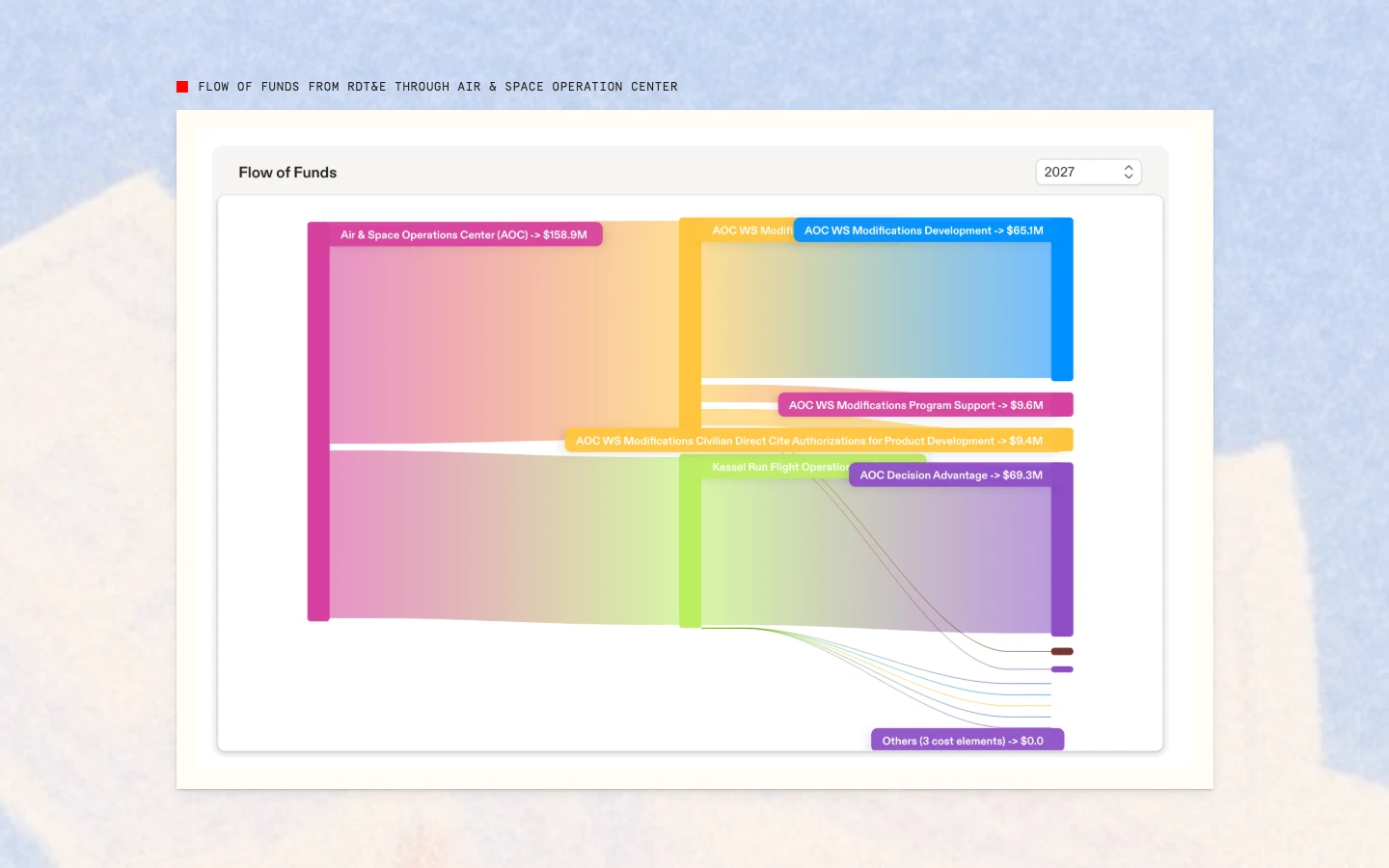
Does the budget match the acquisition strategy?
Funding can be in place while schedules, requirements or contracting plans are still unsettled. Compare the budget profile with award history and active acquisition activity to see whether the program is executing as planned.
How Belisar makes DoD colors of money clear
Traditional budget research means digging through justification books (j-books), spreadsheets, appropriation documents, and disconnected procurement records.
Belisar organizes that data so you can analyze defense funding by color of money and connect it directly to the programs, organizations, contractors, and opportunities that matter to you.
Filter the DoW / DoD budget by appropriation type
Isolate funding by major color:
- RDT&E for emerging technologies and development programs
- Procurement for production, quantities and fielding
- O&M for services, readiness and sustainment
Belisar also captures SBIR/STTR opportunities and classifies them under a dedicated SBIR source, so users can search or filter specifically for active SBIR opportunities.

Combine color-of-money filters with fiscal year, military service, sub-agency, market, program, acquisition owner, execution organization or funding threshold.
Start with a broad question like "Where is Air Force RDT&E growing?" and narrow it to a focused set of addressable programs.
Follow funding through the budget hierarchy
Belisar follows DoD/DoW funding through the underlying budget structure. For RDT&E, that looks like:
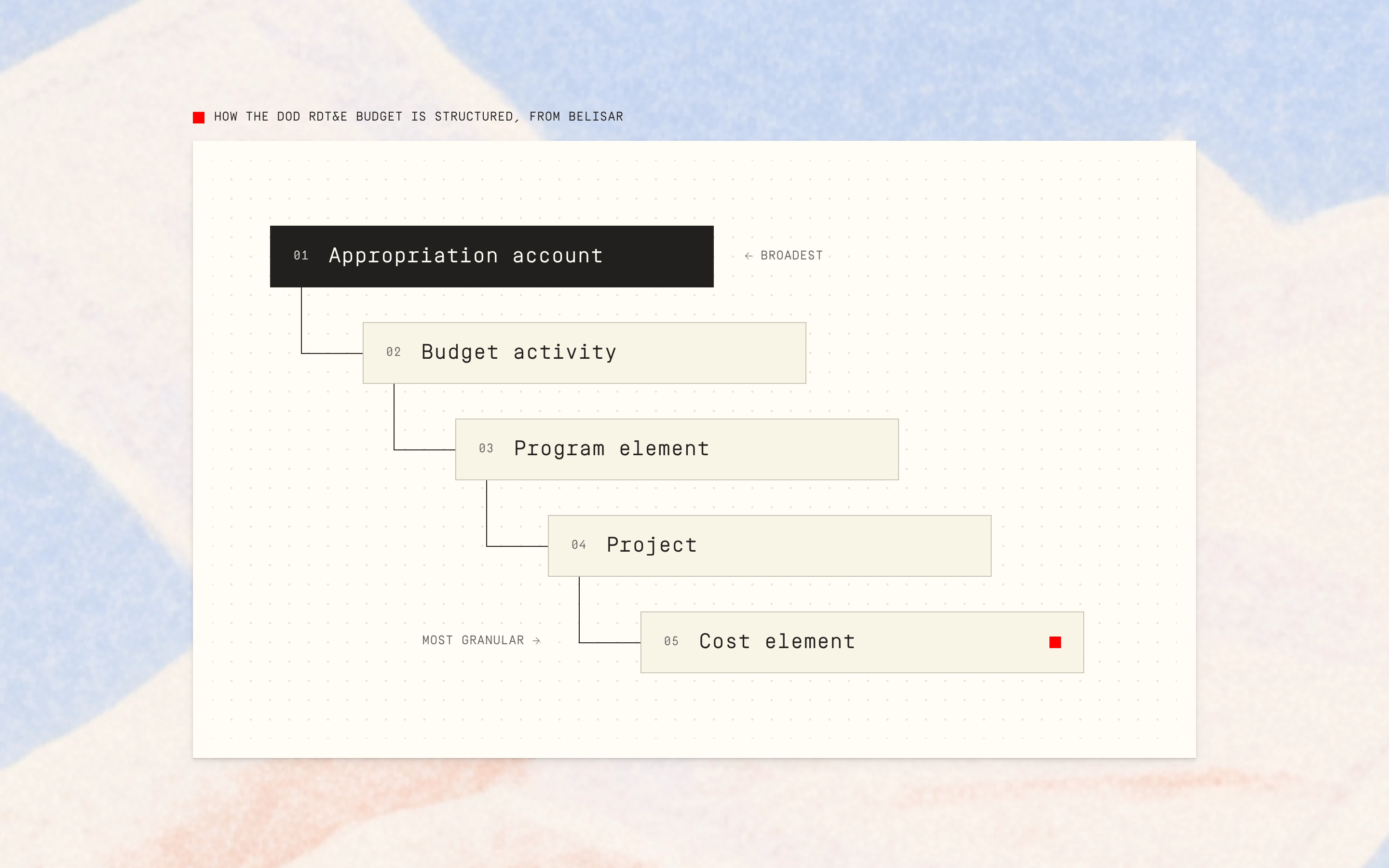
The program element is usually the most useful level for market and capture analysis, because it ties funding to a defined program or capability area. Projects and cost elements add detail where the budget justification provides it.
Higher levels include the funding reported beneath them, so don't add appropriation accounts, program elements and projects together. That double-counts the same dollars.
Compare budget intent with contract execution
Budget data shows what the government intends to fund. Award data shows where contract dollars have actually gone. Opportunity data shows what may be competed next.
Belisar brings these signals together in one place, so your team can tell the difference between a large budget and an opportunity you can actually win.
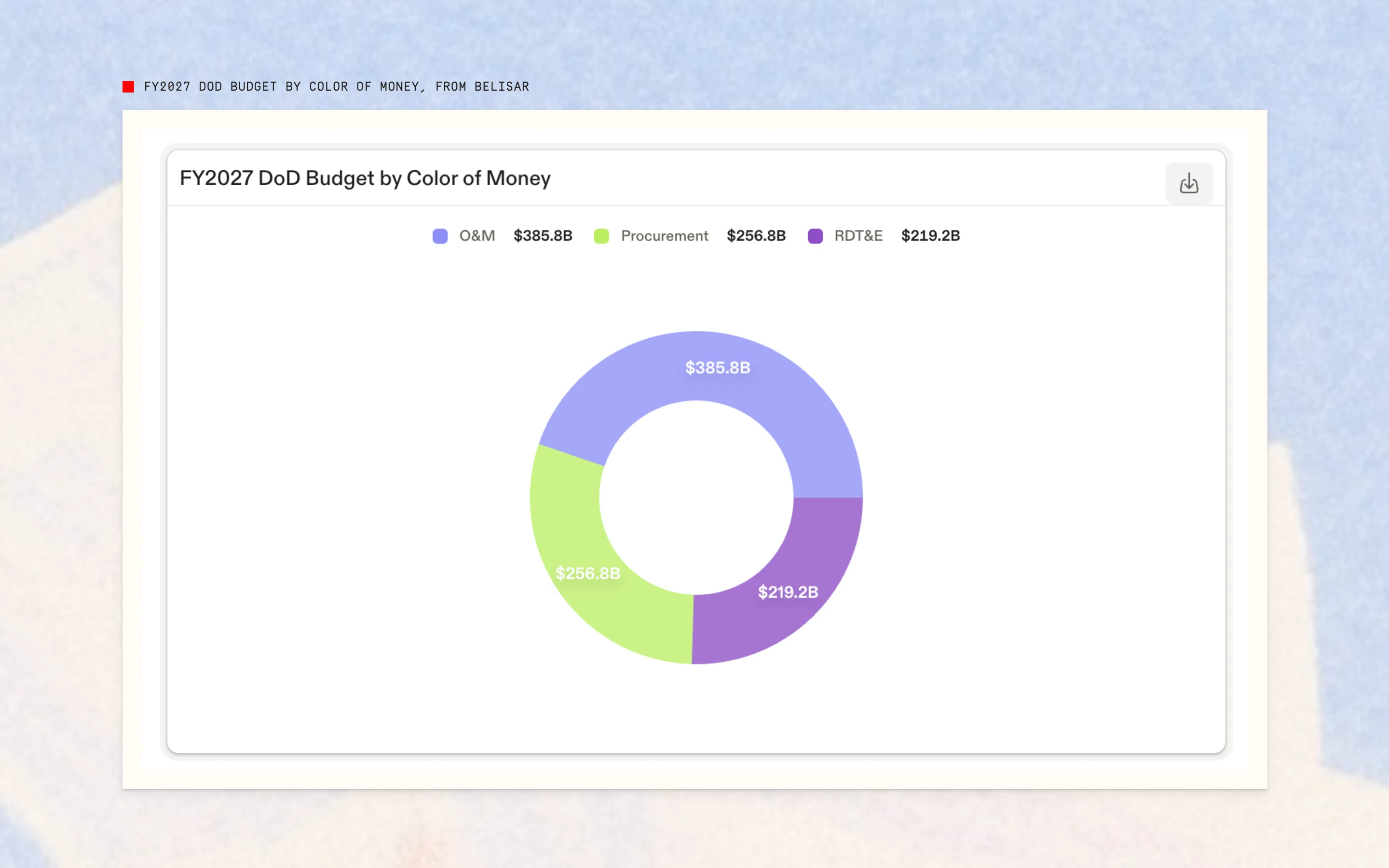
FY2027 DoD funding by major addressable color
Here's the breakdown of the three principal contractor-addressable colors in Belisar's FY2027 DoD budget data:
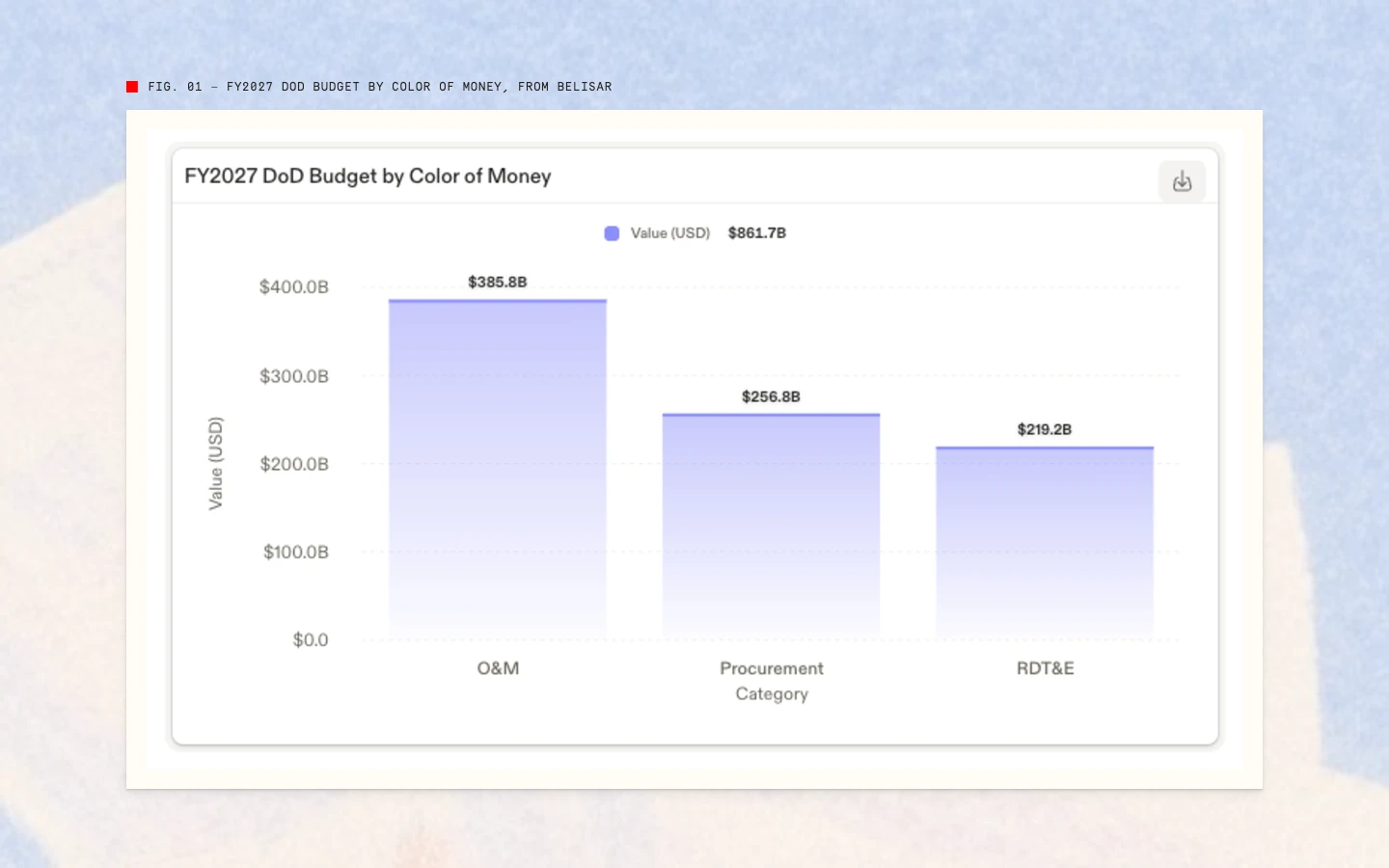
Keep in mind that these figures are budget estimates or requests, not contract obligations. They show where DoD intends to put resources. Further analysis is needed to determine which dollars will become addressable contracts.
Common mistakes when analyzing DoD colors of money
Treating all program funding as interchangeable
Appropriations are legally limited by purpose, time and amount. Funding for one activity generally can't be moved freely to another.
Looking only at the total budget
A program's annual total can hide a critical transition between RDT&E, Procurement and O&M.
Adding multiple budget hierarchy levels
Appropriation accounts, budget activities, program elements and projects are nested. Adding them together overstates available funding, sometimes significantly.
Confusing budget requests with contract obligations
A budget request is not an award. Connect budget data to acquisition plans, historical obligations, incumbent positions and active opportunities.
Assuming a Phase II SBIR award leads to Phase III funding
Even if a successful Phase II proves the technology, it doesn’t guarantee funding for the transition. Phase III depends on a program office having RDT&E, Procurement or O&M dollars set aside for it.
Ignoring funding pushed into later years
A program can look well-funded across the five-year plan, while near-term dollars keep sliding to the right. That can be a sign of schedule risk, technical problems, or delayed procurement.
Read the budget like a capture strategy
Understanding the colors of money is essential to anyone selling into the federal government. They show you what the customer intends to do, and a rough timeline of what’s already happened versus what’s likely to come over the next few years.
RDT&E shows where new capabilities are taking shape. Procurement shows which programs are moving into production. O&M points to large markets for sustainment and recurring services. MILCON and MILPER signal mission growth and future demand.
Belisar connects the DoD budget hierarchy to funding trends, acquisition organizations, award history and emerging opportunities, so you can see these signals early and act on them.
Explore DoD budgets in Belisar.
See where funding is growing, which programs are transitioning and where your next opportunity will come from. Book a demo to see it live.
Frequently Asked Questions
What does "colors of money" mean in DoD?
What does "colors of money" mean in DoD?
It refers to the defense appropriation categories that set the purpose, availability period and rules for federal funds.
What are the main DoD colors of money?
What are the main DoD colors of money?
RDT&E, Procurement, Operations and Maintenance, Military Construction and Military Personnel.
Which color of money funds prototypes?
Which color of money funds prototypes?
Prototypes are usually funded with RDT&E, though the exact approach depends on the effort, acquisition pathway and statutory authority.
Which color pays for production systems?
Which color pays for production systems?
Production systems and end items are generally funded through Procurement appropriations.
Which color funds contractor services?
Which color funds contractor services?
Most recurring contractor services are funded with O&M. Services tied directly to research, development, testing or system acquisition can be funded through other appropriations.
Why do colors of money matter to government contractors?
Why do colors of money matter to government contractors?
They reveal program maturity, likely requirement types, funding timing, acquisition risk and whether a budget line fits your capabilities.
What color of money funds SBIR?
What color of money funds SBIR?
SBIR and STTR Phase I and Phase II awards are funded from a set-aside of DoD’s extramural RDT&E budget. Phase III uses other funds, which can be RDT&E, Procurement or O&M, depending on the work.